

Insulation Myths: Problems Especially in Old Houses
How to think about insulation, especially on historic homes.

Insulation and energy efficiency is a hot topic in building today. It has been a hot topic for maybe the last 20 years, especially as foam insulation has risen in popularity and become a new standard. If you watch many of my YouTube videos, you’ll know that I’m an anti-foamer. Actually, I’m a staunch anti-foamer, and I’m proud of it. Here’s why.
Most houses built before 1950 had no insulation in the walls. Insulation is really a post-WWII invention. It wasn’t until the early 1970s that insulation began to be mandated for all new construction. I think insulation is valuable and important. We insulate our new houses. We have to think carefully when insulating an older house.
If you are opening the walls of an old house, like we did on our 1872 house in Granbury, insulation is obvious. We had to develop specific strategies, but we were always going to insulate the home.


This ad for Weatherwood, circa 1940, is a good example of how the building industry thought about insulation 80 years ago. Weatherwood was a new sheathing material used on exterior and interior walls for insulation. Weatherwood was designed to replace the common industry standard of solid wood sheathing.
Wood sheathing, in 1940, was nothing more than wide boards nailed edge to edge with a slight gap to allow for seasonal wood movement. These boards were known as shiplap, and they made Chip and Joanna Gaines famous on their remodels 20 years ago. Weatherwood worked better than shiplap because the Weatherwood boards were more stable than wood, and thus joints could be tighter.
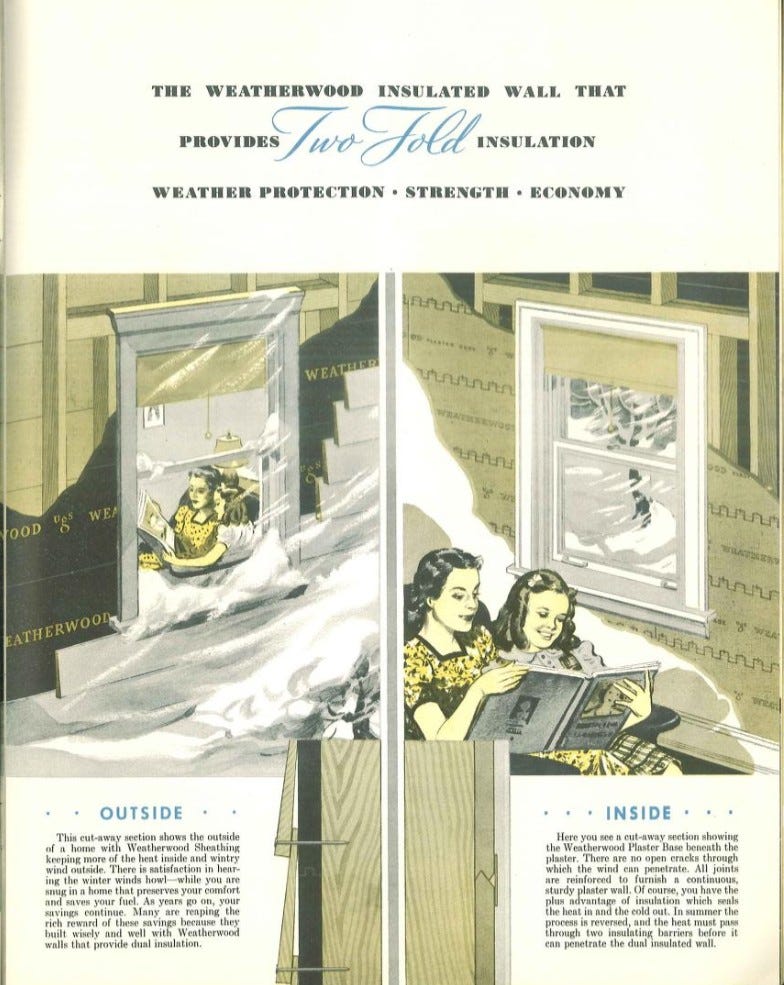
Note on this ad that the wall cavities are empty. It’s kind of wild. I’m not saying no one insulated before WWII. There are ads for Rockwool insulation going back to the mid-1920s.
Fiberglass insulation was invented in 1938 by accident, as researchers at Owens Corning blew compressed air onto molten glass, which made fine threads of glass. What they found was that all of these glass fibers, when bundled together, actually slowed the transfer of heat and cold, and made the walls more energy efficient.
By the 1980s, there were common discussions among builders regarding a wall’s R-value. The R-value is a measure of thermal resistance; a higher R-value means a wall is more thermally resistant. Standard R-values today are R-13 to R-21, depending on if you frame with 2x4s or 2x6s for your walls.
Spray foam started in the ‘70s, gained traction in the ‘80s, and became very prominent in our market in the late 1990s. When foam first came to our market here in Texas, it was almost twice as expensive as fiberglass batt insulation. Since then, the cost for foam insulation has dropped, and ironically, installers increasingly want to use foam because it is much easier to install. Most production homes (which are the cheapest houses built in America) use foam insulation today.
Foam is more efficient per inch than regular fiberglass insulation. It also stops airflow because when it is sprayed into wall cavities, it quickly expands, filling holes and crevices.
My problem with foam is that, more than once, open-cell foam has trapped water in the wall cavities of our projects and caused extensive damage to the floors, ceilings, and walls of the home. It is a silent problem that I fear is the asbestos of our generation.
Please realize that we did not have major mold issues in our homes in the 1940s. It isn’t until we started using foam and sealing up our houses so tightly that mold shows up. I’m not against tight houses, but if something gets wet, it needs to be able to dry out. Foam holds onto water and, like a wet sponge in your wall, can cause a lot of damage.
There was a recent article out of London stating that banks in the UK would not loan money to buy an old house if there was foam in the walls. They were requiring that the foam be removed before they would loan money for purchase. Foam insulation was causing so much rot that houses with foam were a bad investment for the bank.
Last summer I visited Great Dixter in the UK. It is a house worked on by Sir Edwin Lutyens, a famous English architect. Great Dixter had an original home from the 15th century that Lutyens added on to. There is a wonderful Jekyll garden there, if you’d like to visit.
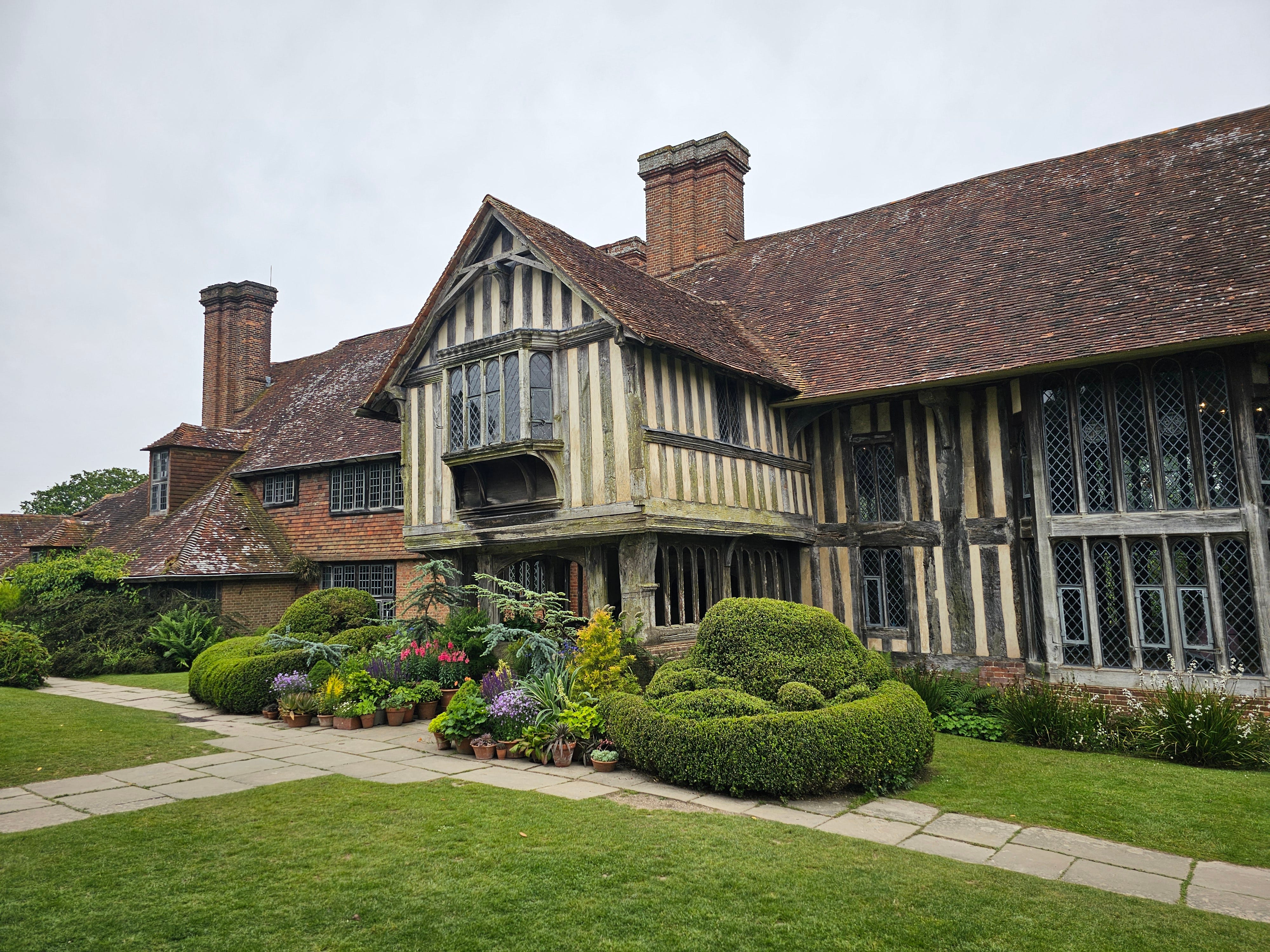
What struck me is that the original portion of the house (right side) is roughly 600 years old. Yes, 600!! That is old, trust me; I’m 1/10th of the way there and I’m already tired. This house has no insulation. They are not using insulated glass. In fact, the windows are not energy-efficient and most don’t open. How many houses built today will last for 600 years? How many windows will last for 600 years?
My point is that we often chase the shining numbers—higher R-value, cheaper costs, easier install, etc.—instead of longevity, sustainability, and beauty. I’m an anti-foamer because I think it ruins buildings. I’m afraid of the roofers who are going to step through the roof of a house because there was a leak 5 years ago that no one knew about. The foam trapped the water, rotted the ceiling joists, and someone fell through. That could even happen on my house, where 10 years ago I thought I was making a great decision I now regret.
At some point, I’ll scrap out the foam and insulate with something else. It is a serious problem that we will regret soon. Like I said, it is our generation’s asbestos. Be careful, I’m just saying…
Welcome to my world!! Thanks for your passion. The goal, my goal, is to make these conversations real and attainable. Thx!
How many houses built today will last for 600 years? How many windows will last for 600 years?
Well, simple answer is none because Americans don't appreciate quality. Everything is disposable, including architecturally significant buildings such as The White House East Wing. The crappy vinyl windows in most houses won't last 30 years. Forget about 600. And yet, most original wood windows can be made efficient with just a little work. We've been dumbed down to throw out high end wood furniture because dark wood is out and white Ikea is all the rage. I need to stop commenting now.... My blood pressure is rising.